
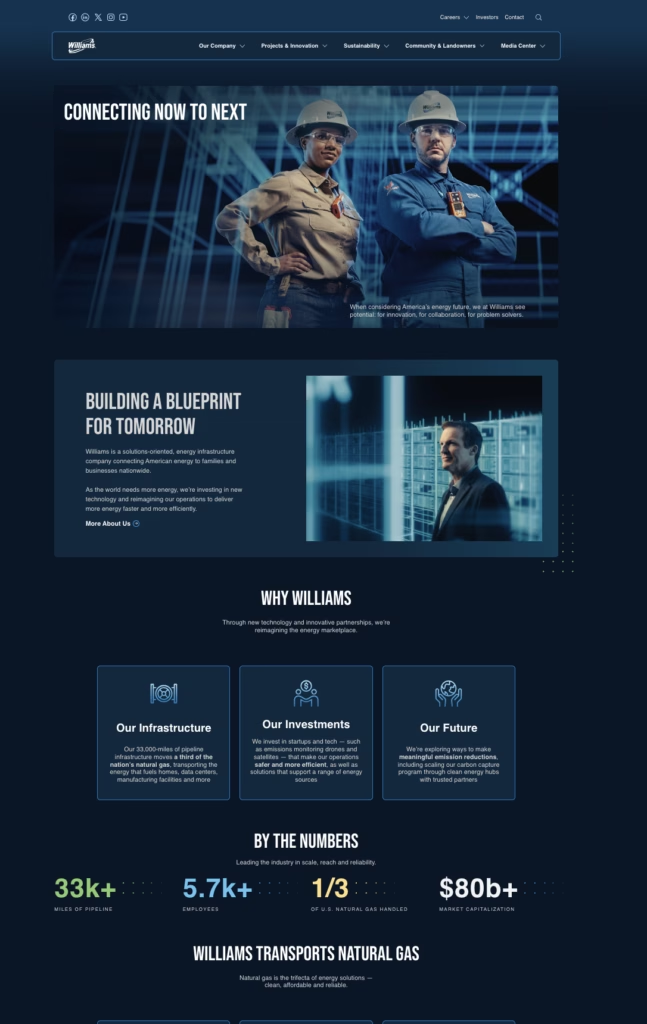
Led delivery of a time-constrained MVP for Williams Energy, transforming an unrealistic full-scope build into a structured, launch-ready product within ~6 weeks of active development. Defined and executed a clear MVP strategy, prioritizing critical user flows while deferring non-essential features. Worked ahead during holiday downtime to de-risk delivery and accelerate progress, enabling the team to hit a non-negotiable launch date without sacrificing quality. The result was a successful on-time launch, strong stakeholder alignment, and a repeatable model for shipping under constraint in enterprise WordPress environments.
Full Case Study
Overview
Williams Energy required a production-ready marketing site delivered on a fixed timeline tied to business and promotional needs. Design approval occurred in mid-December, leaving a narrow delivery window complicated by holiday downtime and reduced team capacity.
I led the effort to reframe the project from a full-scope build into a focused MVP, ensuring we could deliver a high-quality, launch-ready product without missing deadlines or compromising core functionality.
Problem
The project entered development with misaligned scope and timeline.
- Designs were approved immediately before a holiday break
- The timeline did not support a full implementation
- No clear delivery plan existed for navigating reduced team availability
This created significant risk:
- Missing a hard launch deadline
- Shipping a rushed or unstable product
- Overcommitting to scope and blocking delivery entirely
Constraints
- Timeline: Mid-December approval → late January launch (non-negotiable)
- Team: Standard engineering team with reduced availability due to holidays
- Technical: WordPress + Gutenberg with existing patterns and constraints
- Business: Fixed launch date tied to external commitments
- Ambiguity: No defined roadmap for delivering within constraints
Approach
I approached the project as a delivery and prioritization problem, not just an engineering task.
First, I:
- Audited the full design scope and mapped it against the available timeline
- Identified critical user flows and business requirements
- Segmented features into:
- Must ship (MVP-critical)
- Defer (post-launch iteration)
- Remove (non-essential complexity)
I then:
- Defined a clear MVP plan aligned with delivery constraints
- Communicated scope decisions early and explicitly to stakeholders
- Established a focused execution path for the team
This ensured alignment before development scaled, eliminating downstream risk.
Key Decisions & Tradeoffs
1. Scope Reduction vs Product Integrity
- Decision: Cut non-essential visual complexity (e.g., card corner cutouts, extended animation sets)
- Tradeoff: Reduced visual fidelity vs preserving delivery timeline and stability
2. Interaction Depth vs Delivery Speed
- Decision: Retained core interaction patterns, deferred more complex animations
- Tradeoff: Limited initial interactivity vs maintaining a polished baseline experience
3. System Reuse vs New Development
- Decision: Extended existing Gutenberg blocks (e.g., group block variations) instead of building new systems
- Tradeoff: Less customization vs faster implementation and consistency across the site
4. Immediate Execution vs Team Availability
- Decision: Advanced development independently during holiday downtime
- Tradeoff: Increased individual ownership vs reduced risk for overall delivery
5. Clarity vs Overpromising
- Decision: Explicitly defined what would and would not ship at launch
- Tradeoff: Reduced scope expectations vs stronger stakeholder trust
Execution
I owned frontend delivery strategy and execution, while coordinating scope and alignment across stakeholders.
Key contributions included:
- Defining and implementing a component-driven MVP architecture within WordPress Gutenberg
- Extending core Gutenberg blocks (group variations) to support required layouts without introducing unnecessary complexity
- Delivering core user flows and content structures aligned with business needs
- Performing content system cleanup to ensure editorial workflows would not block launch
- Advancing development ahead of team availability, reducing bottlenecks during the final delivery phase
The implementation focused on speed, clarity, and stability, ensuring the product could launch confidently under constrained conditions.
Outcome / Impact
- Delivered on time despite compressed timeline and reduced team capacity
- Eliminated risk of project delay or failure through proactive scoping and execution
- Maintained a high-quality user experience within MVP constraints
Stakeholder response was notably strong:
- Clear communication around scope and tradeoffs resulted in full alignment with no pushback
- Confidence in delivery increased due to transparent prioritization and execution strategy
While formal metrics were not captured, the outcome demonstrated:
- The effectiveness of MVP-first delivery in enterprise environments
- The value of early scope control and proactive execution
What This Enabled
- Provided a stable foundation for post-launch iteration (V2 enhancements)
- Reduced delivery pressure during final phases due to early progress and risk mitigation
- Established a repeatable approach for:
- Shipping under tight deadlines
- Aligning stakeholders through clarity, not overcommitment
This approach reinforced the importance of:
- Prioritization as a core engineering skill
- Clear communication as a delivery multiplier
Key Takeaways
- Shipping is a product decision, not just an engineering task
- Scope control is the highest-leverage tool under constraint
- Proactive execution reduces team-wide risk
- Clarity builds trust faster than overpromising